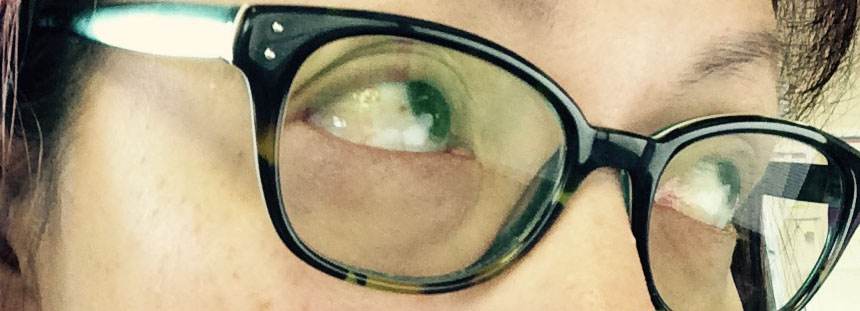
eyeroll

This is a photo of me attempting an eye roll. I’m no good at it anymore.

You’ve heard all the writing talking heads.

There is one school of thought: You’re a writer, you write. You write every day. You write for money. You write to sell. You don’t give anything away. Your sole purpose for writing (besides telling a good story) is to get an agent/contract/publishing house and make it into the big time.

There’s another school of thought: You write because you’re an artist. You might write to hone your craft, or when you are seized by whimsy. You write to create a world, perhaps beautiful, perhaps stark. You write because you enjoy it, not because it’s a job.

Either way, there must be a thread of inspiration. Sometimes it comes easily, sometimes not so much.

I had a very uninspiring 2014. Too much drama, too many bad things visiting me all at once. When it rained, it poured, and poured again. My inspiration was frozen, like a freighter in Lake Michigan in mid-January. Stuck. It sucked.

When my kids were little, I started what I called Forced Family Fun Night. Usually, it was Friday or Saturday. We’d have our meal together, and then take turns picking out and watching a movie. Or we’d go to the symphony en masse. Or we’d go golfing or bowling. The point was to make an appointment to be with the family, the entire family, one day a week.

I can’t believe it, but my kids did this (albeit somewhat grudgingly) until they graduated from high school and flew off to the West Coast for college.

The point is this: sometimes you must force inspiration. Sometimes the Muse (or whatever you want to call it) doesn’t light on your shoulder  and sprinkle you with fairy dust. Sometimes you have to part a sea of self-doubt and beat the ideas out of your dusty, drafty head.

Sometimes you have to go to a place you don’t want to go to and experience something you’ve never done before. Step outside of your frozen comfort zone and off the cliff. The best inspiration comes from putting yourself into an uncomfortable situation.

And me? I’m going there. Right now. Write now.
Posted in books, DIY, editing, indie publishing, Joanne Huspek, manners, Monday Blogs, music, violin, writing, women, life, NaNoWriMo, people, querying, reading, rewriting, Self publishing, womens literature, writers conference, writing | Tagged , , , , , , Comment

wordsWhile I was at the San Francisco Writers Conference in February, I sat in on a few workshops with my favorite author (well, definitely in the top three!), Michelle Richmond. Not only does she NOT outline, she doesn’t write in a linear fashion. (My kinda writer. An organized pantser.)

Another news flash: She also writes what she doesn’t know.

I know, I know. Writers are often told to embrace what they know and write about that. This was the first time a major author told us to consider writing what you don’t know.

I can see the value in this. First of all, if you are penning fiction that closely follows what happened in Real Life, you will often receive critiques. “This is unbelievable!” and then the resultant response, “But it really happened!” “But it’s not real!”

Good Lord.

Sometimes Real Life is too much. Real experiences sometimes are too graphic. A fictional story might be based in fact, but it doesn’t require an angst overload. However, your story does need enough conflict to keep the reader interested.

A little careful teasing helps here.

Also, if we are too familiar with a story, if we write more as a journalist instead of as an entertaining storyteller, we will focus too closely on the facts, to the exclusion of other possibilities with your story.

My novels are based in part on Real Life. The Virtual Moms are my fictional adaptation of the Beanie Mom online group I’ve belonged to for nearly 20 years. In some cases, a personality might be loosely based on one of my friends, but in other cases, I found I had to jazz up some of my characters. Give them recognizable quirks and personalities that are uniquely different from my real friends. I also had to come up with a plot that while it might have been plausible, it definitely did NOT happen to us.

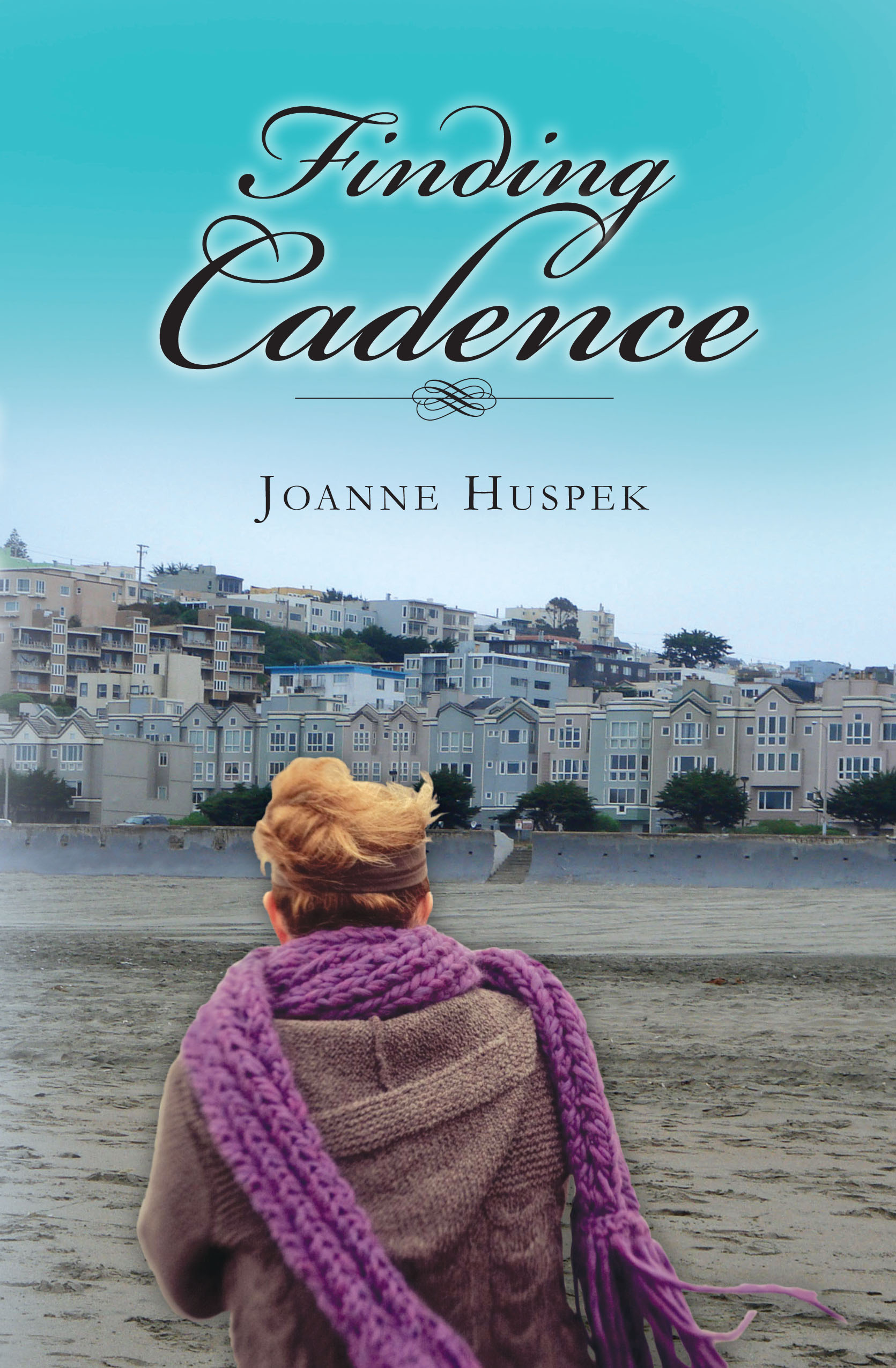
The same holds true for Finding Cadence. People who know me saw my house as Cadence’s house; they knew which high-profile attorney I used as a muse for my antagonist; my son attended the San Francisco Conservatory; I grew up in Colorado. Most importantly, I’ve experienced that love and loss, the close but strained relationships between mother and child, spouses, and sisters.

But I had to change it up, and I did. I don’t write memoir; I write fiction, and most of the tale is just that – a story I concocted in my head.

Michelle Richmond writes what she doesn’t know as a way to get her to step outside herself and what she does know. She confessed that Golden State was written in this way. It’s an excellent idea, which requires the writer to research. Research equals found knowledge. The writer sees things from a different angle of the life prism. Not only does it expand the writer’s world, it expands the scope of writing.

After I get my current edit out of the way, I’m working (using the Paperclip Method) on the next story, which is now in bits and pieces. I think I’ll step way outside of my comfort zone and write about what I don’t know.

Posted in books, Finding Cadence, indie publishing, Joanne Huspek, Monday Blogs, people, reading, San Francisco, San Francisco Writers Conference, VIRTUALLY YOURS, womens literature, writers conference, writing | Tagged , , , , , , , , , 1 Comment

sharing the love

As an author, you would like to believe that the worlds and situations you have crafted have inspired or touched your readers. Yes, we long for validation. We’re the twirling ballerinas yelling “Look at me! Look at me!” But besides being shameful exhibitionists (and some of us waiting for the “Big Break”), most writers want to know that we did a good job with our stories.

In some ways, I don’t care if I’m liked or not. My first motivation for writing is to get my story out. My next is to write well. Once that’s completed, I can think about my readers. I’m honestly concerned about them. Did they laugh? Did they cry? Did they figure out the mystery? Did the characters seem real, as in multi-dimensional? Was the story believable? Were my readers entertained? Would they read more of my writing?

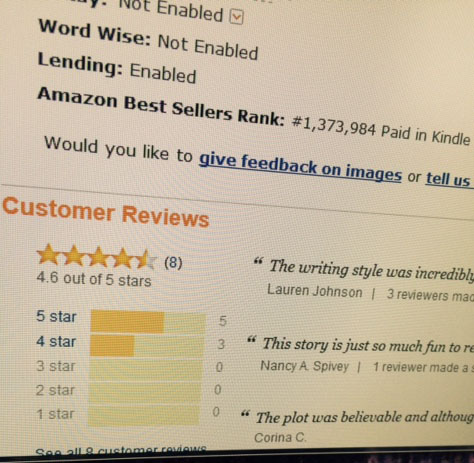
I used to write reviews, before I got caught up in my own writing. I might still if I’m really touched by a novel. I thought I wrote honest reviews, asking myself the very same questions I’ve listed above. The first rule of writing (or reading) a review is that it’s a subjective exercise. The reviewer’s opinion is not the end-all be-all. You shouldn’t base your art on what other people think. If you’re in the market to read, you shouldn’t be too swayed by the reviews of others. It’s nice to have a positive review or two (or three, like in the photo above for Virtually Yours), it’s better to have a constructive review, but there is a silver lining for bad reviews. Even bad publicity is publicity. Look at 50 Shades of Gray. It’s not my idea of a perfect read, but millions of people liked it. Even I bought the book, simply on the negative publicity.

If you’re a reader, you should provide feedback to the author. You don’t have to meet them and gush, or write them a letter and gush, although I’ve done both. Modern technology makes the ratings game so simple. I might not have the time to write a full review, but I do have time to rate books. (An aside: I used to only rate on sites like Amazon or Goodreads. I rarely read the actual comments, nor did I make any.) It takes less than a second to voice your opinion.

It takes the same amount of time to click one star as it does five. (I’m hungry. I’ll even take one star.)

It takes less than a second to like this blog post or to subscribe to it.

It takes less than a second to like my newly hatched Facebook page.

It takes less than a second to retweet an author post.

Even a brief nod is a nod.

Sharing the love: it’s what I do. Now go share the love with authors you know and admire.


Posted in books, editing, Finding Cadence, indie publishing, Joanne Huspek, manners, Monday Blogs, NaNoWriMo, people, reading, VIRTUALLY YOURS, womens literature, writers conference, writing | Tagged , , , , , , , , Comment

michelle richmond books

While at last month’s San Francisco Writers Conference, I sat in on a workshop given by Michelle Richmond (one of my favorite authors, if you haven’t read her, DO) on writing a novel by the “Paperclip Method.”

Okay, so at first I was star-struck. I am in the process of buying every book Michelle Richmond has ever written (along with Laura Kasischke and T. Greenwood – my bookshelves are bursting). These three women are, in my honest opinion, the greatest writers of these modern times. Their books are lyric, complicated, literary, sometimes gritty and real – basically they touch my heart in ways that can’t be explained with mere words. I find myself thinking about the characters long after I’ve read to the end.

Back to the workshop – I finally came out of my hero fog and began to listen. I had no  idea what the “Paperclip Method” was; I would have listened to Michelle Richmond reading from the phone book. I would have listened to her critique my first page to shreds. But after a few minutes of her talk, I realized that Michelle Richmond writes like I do. Talk about a hit-by-lightning moment!

Unlike most writers, Michelle Richmond does not write in a linear fashion (start on Page 1, end with “The End.”) She also doesn’t use outlines. Boom, and boom! Neither do I! And here I thought I was ADD, unable to start at the beginning, unable to know what I’m going to say in advance. *duh*

You might know what your next novel is. I kinda-sorta do. I’ve been working (lackadaisically) on a story about three women since last summer when I took some online classes with The WriterMama. Her 21 Moments class gives you a prompt each day to write about a “moment” in time. After six months, I had a notebook (hand written) filled with moments, most of which had to do with these three characters.

Do the math. If I was writing between 500 and 1000 words each day for 21 days each month for six months, I had a reserve of at least 63K words worth of story. All I had to do was to weave it together. Yeah, right. I tried to explain my story to my Editor for Life, but he was busy editing VY4ever. So the notebook has been fermenting since last July.

But listening to Michelle Richmond explain the Paperclip Method renewed my interest in the story. Her method involves writing in scenes or short pieces. (It helps to have a vague idea of the story line.) Once you have enough small pieces, you arrange them into stacks and use paperclips to keep the stacks separate. Scenes with specific characters might have their own stacks. Writing that might have to do with the theme of your novel. Maybe a parallel storyline that seems inconsequential but presents a hidden meaning for the main story in the end. Eventually, you study your stacks and piece your story together.

Like a quilt! Like one of my twisted pieces of jewelry! These start out with small pieces that are seemingly unrelated, but eventually make up a work of art.

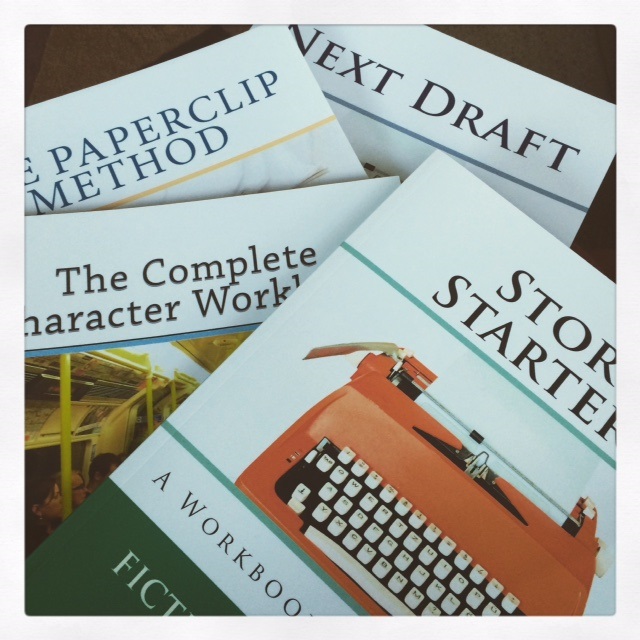
After the dust settled from my trip, I went online and purchased Michelle Richmond’s workbooks, which are pictured above. They arrived this week. And now, I will retrieve my handwritten notebook and start paperclipping.

After all, there’s more than one way to skin a cat, or write a novel.


Posted in books, DIY, indie publishing, Joanne Huspek, manners, people, reading, rewriting, San Francisco Writers Conference, womens literature, writers conference, writing | Tagged , , , , , , , , , , , , Comment

02-19One short week ago, I was in San Francisco packing my bag for the return trip home. I’d spent a nice, long weekend at the San Francisco Writers Conference, and another week enjoying the City by the Bay (and my son).

I’m always amazed at the stuff I bring home: business cards from fellow writers or presenters; hand-outs galore; books (like I can keep from buying books when there’s an in-house mini-bookstore?); chatzkis like pens and bookmarks and bags and other things. After I’ve emptied my bag, done a quick load or two of laundry, and inventoried the souvenirs I purchased for my office staff, it’s time to sort through the bounty of information I’ve culled from the conference.

The wonderful thing about the San Francisco Writers Conference (besides getting to meet my favorite writer of all time, Michelle Richmond — swoon, tongue-tied, instant fever) is that everyone is so helpful, and the help extends way past February. In fact, I’d like to think none of these people want to be emailed 25 minutes after the last workshop. If they’re anything like me, they will want to decompress and let the whirlwind of the conference settle before tackling anything that resembles work.

In my case, since I didn’t pitch to any agents this year (working on edits, have nothing finished to pitch), I concentrated on gaining information. This year, it was filling my little pea-brain with everything Internet and social media.

I know I’m an old lady, but I do try to keep up. I learn by trial and error. I learn by watching others do it. I learn by reading up on the subject (of course, most of that flies right over my head).

Imagine my surprise when I learned I was approaching social media all wrong. The tweeting, the Facebook, the blog – all wrong! Savvy social media-ites have a system. My system is this: 5-10 minutes on Facebook, keep Twitter open while I work and occasionally scan it for interesting items, blog once a week (sometimes twice a month), and don’t push my book at all (well, maybe some half-hearted attempts).

This is not a good system.

I learned a few things:

Facebook is not my friend, nor is it much of a friend to any writer or business. I’d suspected that for some time. It’s undergoing some changes, there’s a shift in algorithms so that not everyone in your sphere of influence sees your posts. It’s not quite a needle in a haystack, but it’s getting there.

You can schedule tweets! No joke! Now, of course, I have to learn how to do this. I tried TweetDeck many years ago and didn’t get it. Fast forward to today, a new TweetDeck installed, and I still don’t get it. (I may have to email one of the new friends I made at the conference, the ones who actually have a clue.) Also, I learned that there are prime times for tweeting, where one gets the most bang for their buck, and that there’s a content tweet percentage – 20% personal, 80% tweets on other things. Who knew?

I should blog more regularly. And, I should always include a photograph with a blog post. I’ve done that at times, but now I’ll do it each post. Something about the fact that most Internet content is visual and people are drawn to photographs.

The one thing I have done right? Using Pinterest for writing. I’ve used it to sketch out story lines, to post flash (it’s got to be flash on the P – you are only allotted 500 characters), and as a pin board for my novels.

Today, I’m sorting through my business cards; tomorrow I will touch base with the presenters I was most impressed with and thank them for their information and say hello to the writers I’ve met.

A writers conference doesn’t end when you say goodbye. This is what makes going to them so valuable. The information that you garner, the friendships that you make, the electricity of ideas that jump start your own flagging ambition – all of this makes attending so worth the monetary expense.

Posted in books, DIY, editing, Finding Cadence, indie publishing, Joanne Huspek, music, violin, writing, women, life, people, querying, reading, rewriting, San Francisco, San Francisco Writers Conference, Self publishing | Tagged , , , , , , , Comment

sanfranciscoI’m giddy! This Wednesday, I’ll be traveling to San Francisco. It’s not just to escape the cold, the snow, and the grey. I hope to learn a few things this weekend.

This weekend I’ll be attending my seventh San Francisco Writers Conference. If you’ve followed this blog from the beginning, you’d know that I started writing it in 2009, the weekend before my first conference, and days after completing my first novel, Finding Cadence.

I strongly urge all writers to attend conferences. Yes, even the introverts pecking away in the dark, the ones who can barely make human eye contact much less conversation. It’s expensive, yes, but choose one. Attending a conference might be the jolt of inspiration you need. The knowledge you gain, the friends you’ll make, the networking you’ll find – makes a writers conference so valuable.

I’ve read a lot of blogs outlining what you should bring to a writers conference (pitch, synopsis, smile, laptop, pen, comfortable shoes, clothing in layers), but rarely have I read anything regarding what NOT to bring.

Now that I’m a veteran attendee, I’ve witnessed a wide gamut of behavior from very, very good to cringe-worthy. Here is my brief list of what NOT to bring to a writers conference.

1. Leave your delusion of grandeur at home. Yes, your novel might be the best thing since The Great Gatsby, or maybe it’s not quite there and needs some TLC. Save your attitude for when you’re on the NY Times best sellers list.

2. Don’t bring your sour face. Maybe you’ve been toiling at this writing game for years and years and YEARS. You’ve sent out a couple hundred query letters, half of which are rejected, some auto-rejects, the rest scathing (or not) personal missives telling you “Sorry, not interested.” After years of being worn down, you think agents are the devil’s spawn, since all of them have dissed your work. Whatever you do, do not wear your disappointment where other attendees (including agents) can see.

3. Get rid of your protective shell, at least for the conference. Shed your turtle coat and let it all hang out. Sure, you’ll be left in a vulnerable position, but repeat after me, “They will not eat me.” The other writers are not your mortal enemies, and neither are the agents. (Tip: If you smile, you might make some friends.)

4. Don’t bring your closed mind. You will attend many workshops and absorb a lot of information in these three short days. Instead of discounting the possibilities, carefully consider the material that is presented to you. After studying the options, you might find that “this” technique or “that” approach might work for you. Or not.

5. Forget your hound dog nose, too. Agents and presenters can be a friendly bunch, but stalking is not recommended – unless done discreetly, of course. (Do you really want to be known as that writer?) Save your dogged perseverance for later. Like when you’re feeling dejected and want to throw in the writing towel.

Me? I plan on not pitching, even though I have two novels in various states of disrepair. I plan instead on listening very carefully, garnering all the knowledge I can, and furiously writing notes.

And now…I must pack.

See you on the other side.

Posted in books, DIY, editing, Finding Cadence, indie publishing, Joanne Huspek, manners, NaNoWriMo, people, querying, reading, San Francisco, San Francisco Writers Conference, Self publishing, womens literature, writers conference, writing | Tagged , , , , , , , , , Comment

After my second (or third, I forget) edit of Virtually Yours Forever, I decided to run my novel through Smart Edit.

Smart Edit, for those who don’t know, is writing software that takes your words (yes, even novel length) and analyzes your word usage. In just a few short minutes, all of the glaring errors you thought you had avoided slap you upside the head. Overuse of adverbs and adjectives, phrases, what I call “dumb” words (really, like, the to-be words), redundancies, and cliches. It counts your exclamation points, apostrophes, and hyphens.

Smart Edit was the best $57 I ever spent.

I ran my final draft of Finding Cadence through it, and managed to eliminate 10K words. This book’s first draft started at 175K, whittled down to 130K (after I found I had used the word “family” 900+ times and “perfect” 700+ times – completely unnecessary), and finally pared to the 120K, which is still perhaps too long, but at that point I couldn’t take anything else out without compromising my story.

With the current pass at my Virtual Mommies, I want to tighten up what words I have in order to adequately express my parallel story line. I’m only on Draft A of the inserted story, so I have a way to go before completion. But at 92K, I’ll safely stay on the low side of 100K.

I’ve often said that I write how I speak. This talent might make for interesting dialogue, but the spoken word is full of redundancies. Yes, I visibly cringe when I see what Smart Edit decides to spit back at me. I’ve only been writing novels for a few years, but I take this craft very seriously. I read and house an impressive library of writing reference material. “You’d think you’d learn?” I say to myself.

I’m learning, but at a snail’s pace (yes, a cliche). And I’m OLD, meaning I can forget things now with amazing speed. (I long for those days when I could hear a song on the radio twice and remember the words.)

I’m not one of those writers who believe in the non-usage of adjectives and adverbs. I love descriptors, but you don’t want to read the same word over and over. I strive to limit my descriptor usage to less than five times in 100K.

It’s the same with phrase redundancies – unless the phrase is a signature speech pattern. For example, Janna always says “Oh, my Lady GaGa” because she’s Jewish and never says the word “God.” Or how I have Ashe signing off on email either “Virtually yours forever” or “Peace out.” But if Smart Edit shows 37 “you have tos,” I know I must get in there and change at least 30 of them to something else.

There is an upside to having all of your errors staring you in your face. You won’t find  900-anythings in my manuscripts anymore, which means I must be learning from my mistakes.

Posted in books, DIY, editing, indie publishing, Joanne Huspek, people, reading, rewriting, womens literature, writing | Tagged , , , , , , , , Comment